Tuesday, 2 May 2023

Venus spotted in Swansea Pride March 2023


In ancient times the goddesses Venus and Aphrodite were significantly involved many aspects of life - including politics! Aphrodite was also particularly associated with gender diversity and same-gender sexuality (look at her bearded or phallic iconography, her son with Hermes, Hermaphoditus, and her association with Sappho). 

Shown above is a photo taken at an LGBT+ Pride Parade in Swansea, Wales (UK), where representatives of the local Pagan community march with an image of Venus.

Clearly, her modern devotees are recalling these traditions, calling upon Venus as an ally to LGBT+ people in protest and celebration.

This is something that I discuss in my case study chapter on Aphrodite.


Friday, 13 January 2023

Entering the Fourth & Final Year

This research is now in its fourth and final year and so, as of the 10th January 2023, opportunities for participants to get involved have now closed.

This year will be spent writing up my conclusions, collating data from the questionnaires, and general formatting. I am also working on a chapter for the upcoming edited volume, Persephone in Love, writing about the reception of the Persephone-Hades pairing in Goddess Spirituality. Although Persephone has not been a goddess central to my thesis, much of the content of this chapter has been informed through peripheral study and through the key interpretative lenses of Goddess Spirituality (discussed in my first chapter). So this is what I will be focusing on now, alongside completing the final stage of the thesis.

I am extremely grateful to everyone who has responded to questionnaires and interview questions, shared images with me, and welcomed me to attend online ceremonies for passive participant observation. I hope that you will find the thesis affirming, challenging, and enlightening.

Thursday, 23 June 2022

Feminine Power Exhibition

Over the last year or so I have had the honour of working with the British Museum alongside the Children of Artemis as a community consultant for the Feminine Power: divine to the demonic exhibition. Together we met with the curatorial team to provide insights for the section entitled, 'Magic and Malice', which drew specific attention to the fear of women's magic and witches during the Middle Ages.

Olivia Ciaccia standing in front of the exhibit
containing thanks to the CoA consultants


I plan to incorporate some highlights about the exhibition and receptions from the visiting Goddess devotees into my Tangible Heritage thesis chapter. In the meantime I have written a short blog post about the exhibition for Mainly Museums, which you can read here.


Sunday, 23 January 2022

What have I been up to these last months?

As the chaos of the winter holiday and new year draw to a close (hopefully!) I thought it was appropriate to provide some updates about what I have been up to over the Autumn and Winter past.

- Following on from my trip to Greece at the end of September 2021 - where my partner and I consumed as much history 10 days would allow - I spent October finalising my Round 3 questionnaire and passing the ethics review before sharing it with potential respondents (Round 3: https://forms.office.com/r/90jCVUTKMn). 

- In October I submitted an article to the Children of Artemis's Witchcraft & Wicca magazine. Here I outlined my study and invited readers to participate. (At the time of writing I thought I would be unable to include my Sekhmet chapter in the thesis - but since realised that I can!) I also submitted an small advert to the Pagan Federation's Samhain issue of Pagan Dawn magazine.

Article in issue 36 of Witchcraft & Wicca magazine.


- In November I received peer reviewer and editor comments for an article I submitted to the Pomegranate Journal back in December 2020. I spent this month implementing the comments and suggestions, and ended up editing more than I had anticipated.

- Thanks to the Keil Scholarship award, of which I am a recipient, I was able to partake in an online course by GIRES entitled 'Introduction to Digital Humanities'. It is my hope that such courses will upskill me for a future career in the heritage industry.

- December was primarily occupied with personal matters and the winter holidays.

- This January I have been editing the final draft of my chapter for the Women in Classical Video Games edited volume, following peer reviewer and editor comments. Happily, I submitted this today!

This week I am due to submit documentation for my second Annual Progress Monitoring (APM), supporting my continued PhD candidature. As soon as February arrives I will be returning my full attention to the thesis itself. My next steps are:

  • Reach out to more Goddess Communities, feminist and organisations, and religious studies organisations, advertising the project and questionnaires.
  • Make progress on my reading list for Chapter 6 (Engagement with Heritage & Scholars).
  • Start drafting paragraphs into Chapter 6.


Wednesday, 27 October 2021

Cover reveal for 'Women in Classical Video Games'

I am absolutely thrilled to share the cover for the forthcoming volume, Women in Classical Video Games, edited by Jane Draycott and Kate Cook (published by Bloomsbury Classical Studies & Archaeology).

Every chapter sounds fascinating to me and I cannot wait to read through! It is also where my debut (scholarly) publication will appear, in a chapter entitled: 'Opening Pandora's Box: Aphrodite as the representation of women's sexuality in God of War III'. Once published, I will share details for ordering the book.


Sekhmet chapter re-introduced into the main thesis

A few months back I reluctantly decided to remove my Sekhmet chapter from the main thesis, owing to word count, resigning myself to publish it separately. However, this week my partner and fellow PhD student Thomas Husøy sat down with me and realised that I had miscounted and had plenty of room remaining! (I don't know how I had got it so wrong...). So, Sekhmet is back in the thesis and I am now plotting the course of my final chapter: Engagement with Heritage & Scholars. The discussions on tensions and mutually beneficial relationships will be partly featured here and in the thesis conclusions.

My revised thesis plan is now thus:

     1. Introduction (part-drafted)
     2. The Reception of Ancient Goddesses ✔
     3. Case Study: Aset-Isis ✔
     4. Case Study: Aphrodite (case study)✔
     5. Case Study: Sekhmet ✔
     6. Engagement with Heritage & Scholars (in process)
                                                                        7. Conclusions (not started)

Today I also officially sent off my final questionnaire for ethics review. Once it is accepted all 3 questionnaires will be available to participants, and I have created nice adverts for the occasion!


Saturday, 9 October 2021

Updates so far

I have now submitted three/four thesis chapter drafts to my supervisors, with one more to write before I tackle my introduction and conclusion!

  • 1. Introduction (part-drafted)
  • 2. The Reception of Ancient Goddesses ✔
  • 3. Isis (case study) ✔
  • 4. Aphrodite (case study)✔
  • 5. Towards a Mutually Beneficial Relationship (in process)
  • 6. Conclusions (not started)

I have one more questionnaire to release for my upcoming section 5, where I am going to delve deeper into the sources of tension between Goddess devotees, scholars, and heritage professionals, and suggestions from each community for moving towards a more mutually beneficial relationship. This questionnaire will be focused on devotee engagement with heritage sites and museums.

My previous two questionnaires will remain open until the start of my final editing process (expected January 2023), so please do continue sharing them!

So far I have had the privilege to interview 21 devotees through video call and email, and have had around 200 questionnaire responses. I still welcome more interviewees, as well as photographic submissions of altars and GS material culture.

Isis at Marathon, Greece
 
Some of you may be wondering what has happened with my third case study on Sekhmet: owing to a limited word count, however, this will need to be published in the eventual thesis monograph (fingers crossed) and/or edited for submission to an academic journal. I very much enjoyed writing that chapter, and had some great responses from Sekhmet devotees - so I promise, this will still be published, though separate to the thesis.

In other news, I have just returned from a week in Greece, spent with my partner exploring as many heritage sites and museums as we could! I will endeavour to share some of my highlights on this blog in due course - especially those relating to Greek goddesses.

I have also signed for a training course this November, focused on Digital Heritage, which I am sure will be of benefit to my ethnographic research, as well as future career prospects.

For now, onto the next chapter!

Saturday, 21 August 2021

Seeking Goddess Questionnaire Respondents

My name is Olivia and I am a PhD student at the University of Bristol, researching how adherents of Goddess Spirituality revive ancient Mediterranean and Egyptian goddesses in the 21st century. My goal is to determine ways that we can build a mutually beneficial dialogue between Goddess devotees and scholars of the ancient world. With this, I aim to include different perspectives and experiences within Anglo-American Goddess Spirituality, from people of various ethnicities, sexual orientations, genders, and physical abilities.

If you,
  1. Identify with Goddess Spirituality, 
  2. Engage in Goddess communities in the UK or US
  3. And engage with ancient Mediterranean Goddesses
then I invite you to respond to my thesis questionnaires!


Round 1 is about your spiritual path (in Goddess Spirituality) and how you came to learn about ancient Goddesses: https://forms.office.com/r/s3acd2MvvJ

Round 2 is for those who engage with Aphrodite, Aset-Isis, and/or Sekhmet: https://forms.office.com/r/wHqrjKRn35

You can also request a posted hard copy or a digital download by emailing me at: hg19310@bristol.ac.uk .

Modern altar featuring a replica figurine of a statue of Isis
found in Pompeii


Friday, 7 May 2021

Round 2 Questionnaire available!

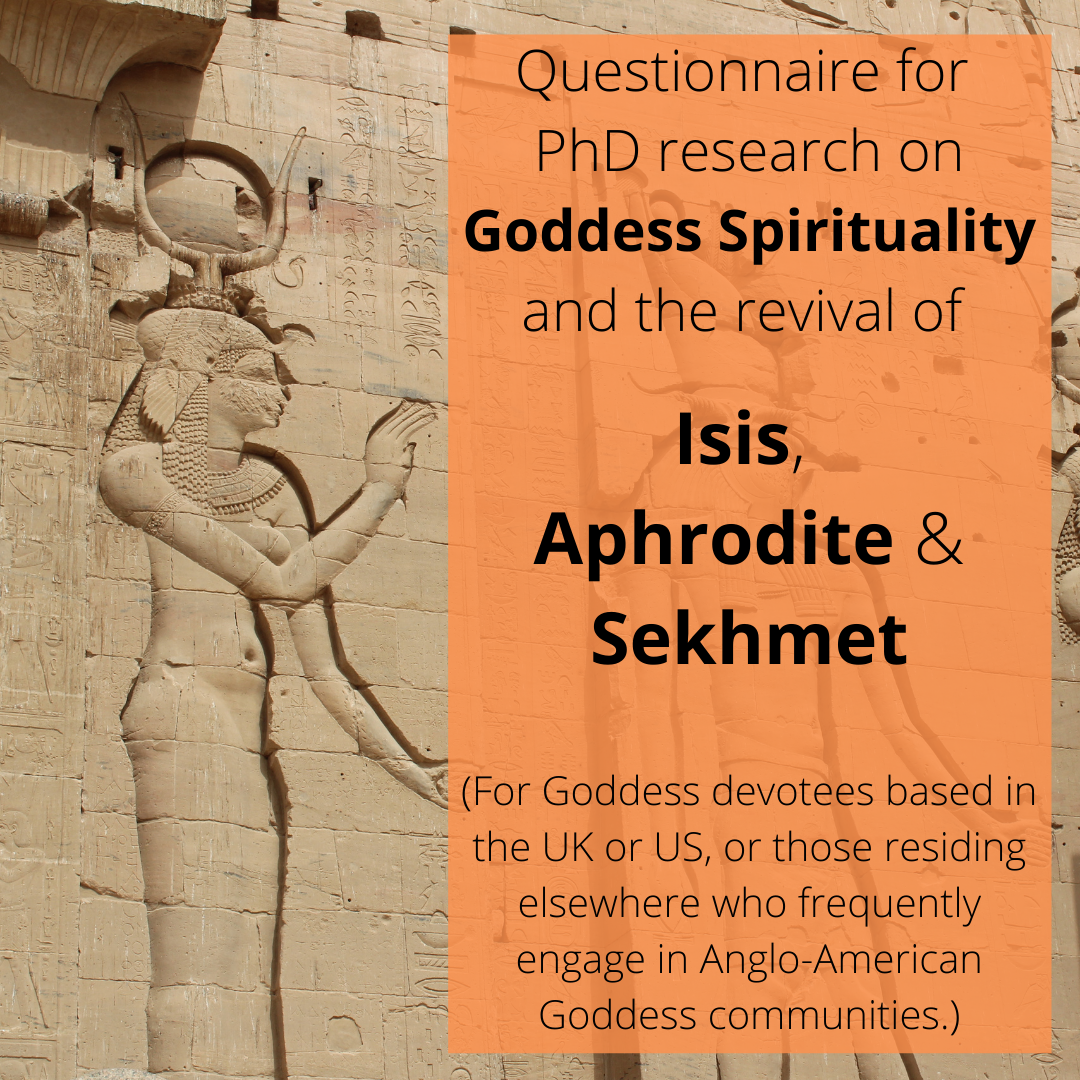
The time has come for Round 2 of my thesis research on Anglo-American Goddess Spirituality in the 21st Century! This time it focuses on the modern veneration of APHRODITE, ASET-ISIS, and SEKHMET. You can respond to it through this link:

https://forms.office.com/r/wHqrjKRn35 

Or you can also request a downloadable digital copy / a paper copy in the post by emailing me: hg19310@bristol.ac.uk

You can also still respond to the Round 1 questionnaire here (the more the merrier!).

To participate in this research, you should fulfil the following:


You are based in the UK or the US (regardless of your nationality), OR you frequently engage with a Goddess Spirituality community in these locations.
You identify with ‘Goddess Spirituality’

And your spiritual path involves the goddesses, Aphrodite (and Venus), Aset-Isis, or Sekhmet.

There are other ways to get involved with my research too! Check on this blog page.


Thursday, 15 April 2021

Pagan Federation 50th Anniversary

This is just a quick message to say that I will be speaking for the Academic Conference part of the Pagan Federation's 50th Anniversary, on the 24th July 2021!

For information about the event please check here: https://www.paganfed.org/50th-anniversary-celebrations/

Event trailer


Monday, 18 January 2021

Moving into my second year of research!

On Wednesday 13th January 2021 I underwent my Annual Progress Monitoring (APM) interview to confirm that I was ready to move into my second year of research. Suffice it to say, I will be progressing! It was actually super nice to audibly talk about my research with the examiners, as for the last 10 months of my first year we've all been in lockdown, more or less. 

I haven't visited Bristol since February. The last (and my first) scholarly talk I presented was for the Myths and Politics seminar series back in June. A PhD can often be a lonely experience, but during 2020 it was even more so. Added to this, is the practical limitation of only being able to access online resources and having no study space outside of our (currently very cold) house. BUT the university library has been very obliging with my eBook requests and I'm glad to be in a safe place with the company of my partner and our cat!

Moving forward, after a supervisory meeting today with Prof. Hutton I have better clarity on my thesis structure. My exploration of my thesis subject will now take the form of three case studies examining the ancient and modern veneration of Aphrodite, Aset-Isis, and Sekhmet. Fortunately I have already written a case study on Aphrodite in preparation for my APM, which I can use the bulk of the official chapter. I also have an article about devotees engaging with statues of Sekhmet in museums (pending acceptance) which can contribute to the chapter on her as well. So I feel that I am in a rather secure place.

My immediate attention will be directed towards my first chapter before the case studies, where I will lay out the context for the revival and innovation of these goddesses in 21st century Goddess Spirituality. Once I have done this I will construct my Round 2 questionnaire aimed towards devotees who revere Aphrodite, Aset-Isis, and Sekhmet - which will get me into the juicy part of this project!


Saturday, 2 January 2021

A Quick Summary of R1Q Quantitative Findings

I want to extend a huge thank you to those who responded to and shared my thesis' Round 1 Questionnaire! I received 113 responses that I could use and am delighted!

I thought it would be of interest for many questionnaire respondents to have a glance at some of the trends I found in the quantitative questionnaire data for Round 1. To avoid publishing my research prematurely I have offered non-statistical summaries below.

  • The majority of respondents identified as feminists and considered this relevant to their spiritual path. However, not all of them did identify this way, and some who were feminists didn't think it was relevant to their spirituality. Based on the responses of these people, feminism is a common component of 21st century Goddess Spirituality, but is by no means a requirement.
  • The majority of respondents accepted the label of ‘Pagan’, with some exceptions who did not think it was a suitable term.
  • Respondents demonstrated a high level of theistic flexibility and the view that multiple theisms could coexist at once. Nevertheless, the most common ways of viewing goddesses was either as archetypes or through polytheism.

  • The language most commonly used to describe one's interaction with goddesses was relational: 'connection' and 'working with', rather than in supplication.
  • Almost all respondents had an interest in ancient history, with just over half having this interest before discovering their spiritual path.
  • Ancient Greek and Egyptian goddesses were amongst the most popular Mediterranean goddesses mentioned, namely, Hekate, Aphrodite, Artemis, Isis, and Sekhmet. Amongst these popular names, there were over 200 additional ones listed, demonstrating a greater awareness of ancient pantheons than the general public. 
  • Respondents predominantly learned about ancient goddesses through a combination of scholarly and spiritual sources, considering each to have its own merits and uses. Overall, respondents valued sources that were historically accurate and wanted spiritual sources to make it clear when they were talking about historical facts versus personal gnosis.
    • There were a few respondents who said that they preferred scholarly resources, however, their listed favourites would not meet current archaeological approval. As such, what is considered as specialised scholarship is a subjective matter. 

Updated characteristics of Goddess Spirituality

Since releasing my Round 1 Questionnaire, I have decided to alter my suggested characteristics defining 21st century Goddess Spirituality. To make it more interesting I have chosen to share these as a series of Instagram images (@teawathena), which I also post here:


Transcriptions:

IMAGE 1 - 'what is Goddess Spirituality? Five common features'

IMAGE 2 - 'Goddess Spirituality can be considered an approach to spirituality, rather than a unified tradition itself. Under the umbrella of Goddess Spirituality there are many different traditions and cultures. Adherents have various practices and use different labels for their spiritual identity (i.e. witch, priestess, druid, Goddess devotee etc.).'

IMAGE 3 - 'Though the approach is recognised as emerging from a culmination of western second-wave feminism, counter-culturalism, New Age philosophy, and neo-Paganisms during the 1970's, Goddess devotees maintain that they are reviving and innovating beliefs once held by ancient religions that revered Goddesses and nature. Goddess Spirituality in the 21st century is multi-generational and international, followed by people of all genders, backgrounds, and ethnicities.'

IMAGE 4 - '1. Goddess-centred. One of more Goddesses are the central focus. Some devotees revere Goddess/es exclusively, whilst others may revere male and androgynous Gods too (though with Goddess/es taking precedence). Goddess Spirituality contains a range of theisms, from monolatry to polytheism, as well as some devotees who prefer to view Goddesses as archetypes'

IMAGE 5 - '2. Feminist / Activist. Goddess Spirituality seeks an alternative to androcentric religions, cultures, and oppressive power-over systems. This manifests through various forms of feminism, as well as personal and/or social activism. Some devotees focus their efforts on personal empowerment, whilst others may combine this with political activism, such as environmentalism and advocating for human rights.'

IMAGE 6 - 'Inspired by the ancient world. Religio-spiritual beliefs and practices may take inspiration from prehistory and ancient religions involving Goddesses and female mythological figures, with a common interest in exploring herstory. Ancient ideas, beliefs, myths, and practices are revived and/or re-interpreted to suit the needs of devotees in the modern world.'

IMAGE 7 - '4. Non-dogmatic & self-led. As Goddess Spirituality is an approach to spirituality and not a religion or tradition itself, there is no dogma or prescribed beliefs and practices. Goddess devotees are encouraged to exercise their own agency in spiritual expression and to develop a relationship with divinity; as such, personal gnosis and experiences take priority.'

IMAGE 8 - 'Sacred Corporeality. The physical world, nature, bodies, and certain objects are believed to hold sacred meaning and be expressions of the divine. Spirituality is experiential and something that can be felt through the body. Goddess devotees believe the Earth to be sacred and that they themselves are a part of the divine. They often make pilgrimages to sacred sites and utilise sacred iconography and ceremonial tools.'

IMAGE 9 –‘The characteristics above relate to Goddess Spirituality as an approach, rather than reflect any specific traditions or groups who identify with it. As such, Goddess devotees and groups do not have to meet every one of these characteristics in order to identify with Goddess Spirituality. Some characteristics might overlap with other spiritual paths and traditions belonging to contemporary Paganism and alternative spirituality.'

IMAGE 10 - 'want to find out more and contribute your ideas? Follow Instagram @teawathena, Twitter @teawithathena, http://teawithathena.blogspot.com/

Sunday, 29 November 2020

Interview as a Keil Scholarship Recipient

Earlier on this year I engaged in a short interview for the University of Bristol, where I shared my experience of receiving the Keil Scholarship and starting my PhD in Historical Studies. This interview was an opportunity to thank the Keil family for their generosity and to highlight the impact that it has had on me so far.

"It’s the gift of a different type of life for someone who wouldn’t have had that chance."

And you can read the experiences of other students here: https://www.bristol.ac.uk/alumni/causes/thank-you/


Tuesday, 3 November 2020

Difficulties in Sampling GS sources

It's about time for a thesis update I feel!

Reflecting back on the first 11 months of my PhD I have learnt a lot about Goddess Spirituality's origins which I had never thought to look much into when I was more fully involved in the movement on a personal level. This has been super interesting and really valuable. It is sometimes easy to make judgments on the past based on current opinions and contexts; but looking at the motivations behind GS and second-wave feminism has really opened my eyes to broader perspectives and experiences.

I now have 119 questionnaire responses - 113 of which I can use - so I am delighted and very grateful! There are so many fascinating insights that have been offered!

The biggest challenge for my thesis this year has been attempting to define what GS is today, and to obtain primary sources and contacts who identify with it. Pre-millennium GS (in its modern manifestation and interpretation) placed an emphasis on feminism, making it a lot easier to identify than it is today. Today, feminism is certainly still involved for the majority of my round 1 questionnaire respondents - but not for all. The early new millennium saw a decrease in feminism as a socially attractive stance. Fast forward into the second decade and it started to become maintstream again. This has had an affect on GS, in that many new adherents happen to align with feminism but it may not be the reason for pursuing GS or be considered relevant to it.

This makes identifiying GS Goddess devotees and related literature hard to find! For one thing, there is no shared label for a Goddess devotee, and devotees may align with additional spiritual paths, thereby going by labels such as "Witch", "Eclectic Pagan", or "Hellenic". This means if I find a YouTube channel or a blog post by an Ecectic witch working with/worshipping Aphrodite, I often need to contact them directly to ask if they align with GS - which also often requires a definition on my part as the term is vague! Some of my questionnaire respondents identify with GS because they primarily work with/worship one or more Goddesses - but they don't adhere to any other the other characteristics gor GS that I suggested. Others identify with  GS but do not consider themselves Goddess-centred because their form of GS embraces all manifestations of deity.

This becomes more complicated when looking at books. Goddess devotees use books from all different traditions and so it is rare for me to find a book that declares itself GS (though there are some). This means that when I am reading the perspectives offered in the book I cannot tell if it is informed through a GS perspective or not. 

There are some very clear sources but typically these are from those who were active in GS pre-millennium. The are still active today so can certainly to referenced - but they may demonstrate a continuation rather than new developments.

This is all super important because it all affects a vast continuum of historical revivial and modern innovation. Early on in my research I can already see that Goddess devotees rest upon the entire spectrum.

So how do I obtain sources which are truly reflective of GS and not other forms of contemporary Paganism?

  • Well, firstly I have advertised my questionnaire and research amongst some relevant online groups and self-identifying Goddess devotees and hope that the word gets out. Self-identification is of course preferred to my own assumptions. 
  • When I search for sources online, I try to ask the author if they identify with GS - though I don't always get responses. I have to make an educated guess, based on my suggested five charactertistics. 
  • I typically consult books and related literature that I know have been used by identifying Goddess devotees; although the author may not identify this way, their work is used to inform GS nonetheless.

  • Importantly, I also have to accept the data I find - which means that in the 21st century there is considerable overlap between GS and other forms of contemporary Paganism. Schoalrship likes things to fit into a tidy box, but traditionally GS has never done so. And that's ok.

Saturday, 19 September 2020

Questionnaires starting to get responses

My initial questionnaire has been open for just over a week now and I have 56 respondents so far. I'm absolutely delighted and fascinated by the answers that have been provided and have spotted some patterns arising. I am eager to start writing about them for chapter 1, though it is hard to make clear assessments until all responses have come back.

Nevertheless, today I am sitting down and beginning to make notes on some of the things I have noticed. One thing I have found to be particularly interesting is that I had previously assumed GS was inherently feminist; however, though the majority of respondents do see themselves as feminist not all of them do. Furthermore, of my 5 diagnostic characteristics of GS "feminist" is actually the least selected option so far (though still common). 

This has prompted me to truly consider how GS comprises many different paths. Goddess-feminism has been studied by scholars before me (Eller, Salomonsen, Coleman...) and comprise one approach to GS; another could be Goddess-centred polytheism, which might not be picked up by scholars as it is often more affiliated with paths such as Hellenism, or Kemeticism. I feel the latter has not been studied to the same extent that the former has. 

I then wonder how do these distinctions affect approaches to the ancient world? Do they at all? My questionnaire shows some differences, but not large-scale ones. We shall see as more responses come through.

Sekhmet Statues at the Louvre, Paris.

Monday, 7 September 2020

Get involved in this research!

 
My name is Olivia and I am a PhD student in Historical Studies at the University of Bristol. I am studying how adherents of Goddess Spirituality are reviving the veneration of ancient Mediterranean goddesses in the 21st century. My goal with this research is to establish how we can build a mutually beneficial dialogue between Goddess devotees and scholars of the ancient world. This call is for those who may wish to participant in this research.

I aim to include a diverse demographic to ensure that it is representative of the many different voices and experiences within modern Goddess Spirituality. I therefore want to learn from people from various ethnicities, sexual orientations, gender identities, and physical abilities. It is my hope that this online call will be able to reach such a demographic of individuals who may wish to put themselves forward for participation.

I invite individuals to volunteer their participation in any of the following capacities:

  • Filling out a questionnaire (online, audio,
    or paper copy upon request) - 
    Questionnaire Link
  • Engaging in an interview (UK in-person if travels permits, otherwise in an online call or through email)
  • Engaging in a focus group (in-person Bristol, UK; or online via Zoom)
  • Inviting me to participate on a pilgrimage tour / to a ceremony / to a related event

 This research invitation is extended to those who fulfil the following:

  • You are based in the UK or the US (regardless of your nationality), OR you frequently engage with a Goddess Spirituality community in these locations.
  • You follow ‘Goddess Spirituality’ (flexible definitions are accepted)
  • Your spiritual path involves goddesses from the ancient Mediterranean*


*For my study I specifically focus on ancient cultures from countries known today as Greece, Italy, Cyprus, Turkey, and Egypt. Please note that Egypt is included in this study because ancient Egyptian culture influenced those of the ancient Mediterranean quite substantially.

I am also keen to hear from scholars of the ancient world and heritage professionals, who may find this research of interest and who may already engage, or wish to engage, with Goddess devotees as a special interest group.

If you are interested or want to know more about what is involved in the above participation, please do get in touch with me:

Email: hg19310@bristol.ac.uk.

Blog: Contact box via https://teawithathena.blogspot.com/

Facebook: https://www.facebook.com/oliviakinsman.bristol/

Twitter: TeaWithAthena


Olivia Kinsman

PhD Candidate Historical Studies, University of Bristol

Supervised by Prof. Ronald Hutton and Dr. Genevieve Lively


Friday, 24 July 2020

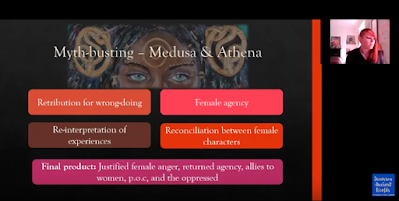
Myth-Busting Recording and Q&A responses

For those of you who missed my seminar presentation for the Myths and Politics series, or who wanted to revisit it, you can view the full presentation here. And if you want to hear a summary interview you can find that here.

I also want to thank each of the 82 participants from across the globe who came to listen and ask questions! As the Q&A was not recorded - and it was such a fun session! - I wanted to take some time on this blog to respond to questions left in the comments section and sent through email. I was re-worded these questions in the absense of permission to quote. These responses are as close to those I offered live, hence why I don't include referenced information.

https://www.youtube.com/watch?v=wNyfJgLBrmo&t=8s
Art by Laura Daligan

1) Athena and Aphrodite are goddesses who mostly lack a maternal aspect in their characters. Can you comment on how this plays into your interpretations of them in the feminist context discussed? 
Starting with Athena, the story of how Hephaistos attempted to seduce Athena comes to mind. The god's seed landed upon the goddesses' thigh, whereupon she wiped it off and threw it to the ground; a child grew from the earth and when he was born Athena returned to claim him as a "foster" mother figure. It is significant that some sources suggest that this child (Erichtonius) had serpent features, which insinuate Athena's maternal connection. With this, Athena manages to maintain her "maidenhood" or independence, but is also able to become a kind of mother. For modern spiritual feminist interpretations, this shows that one does not have to give birth to be a mother, but also that being a mother does not have to occupy ones' indentity.  

This is the same with Aphrodite. We know she was physically a mother of Eros and various other deities, but she does not become a "mother goddess". Children are sometimes a consequence of heterosexual sex, and act of union itself is of her primary concern. Modern devotees recognise that though she is mythically a mother, she is not a mother goddess, recognising this ancient understanding.
2) Could you expand on Aphrodite’s modern role in the LGBT+ community?

This is made very clear by the female same-sex love expressed in Sappho's poetry, which often mention Aphrodite as the goddess behind such desire. Temple of Love, written by devotee Laurelei Black, features an erotic encounter between a priestess and the goddess. Beyond literature, Harita Meenee has written an article which suggests how Aphrodite can be an icon and ally for anti-fascist activism in the modern day - which includes LGBT+ activism. I have also seen LGBT+ pride flags included on devotee altars to Aphrodite, suggesting that she is a goddess of inclusive love and sexuality.

3) Do feminists acknowledge Aphrodite's mythic role in arguably trafficking Helen? And are they any connections with Aphrodite's being an "Eve"?

I have not seen this come up in Goddess Spirituality literature. There is certainly mention of the golden apple that started it all, seen to be evidence of Aphrodite's supreme beauty. Aphrodite's role in causing the Trojan War through obtaining this apple is heralded as evidence of her power. But Helen's agency is not a primary issue that arises... However, Aphrodite's questionable behaviour and the dark side of desire (that leads to sexual violence for example) is acknowledged by devotees.

With connection to Eve, certainly Aphrodite and her girdle of irresistable desire is the ultimate tempresses. She is a warning of giving in to desire for dangerous female sexuality - which remains true for the ancient context as well as today; however, feminists seek to question the "danger" of female sexuality, which is seen as a way of demonising and blaming women's bodies for the behaviour of men.

4) You mention the goddesses in terms of feminist 'icons', how does this work with those who genuinely believe in them as deities?

Goddess Spirituality is a feminist approach to spirituality, rather than a religion of tradition itself. This means that adherents believe in a variety of different theisms. Some may see them as archetypes within the psyche - this might be supported by secular feminists too. You often hear such people saying they "work" with the goddesses - as if they go to them to empower themselves first and foremost. Others believe in them as real deities, where they offer devotion (as well as ask for assistance, and seek empowerment). This can be interpreted as seeing the goddesses as many aspects of One Goddess; others interpret them polytheistically. These theisms can also exist all at once for one individual! So for the purpose of this presentation I have opted for "icons", as this is consistent for all. Each approach interacts with the goddesses as icons in some way, with some going beyond this into genuine reverance as deities.

5) Have you looked into "goddess tours" to heritage sites in the Mediterranean? 

I could easily dedicate an entire thesis to such a topic! This certainly comes up in my research and I'd love to join a tour to glean insights on how Goddess devotees interact with heritage sites. Pilgrimages are a big part of Goddess Spirituality. It is interesting as many devotees feel as if, because their intentions are spiritual they are somehow above other tourists; some also express that goddess sites are a part of their heritage (regardless of their nationality). On the one hand this means they want to hel protect sites, teaching about them, advocating visits, and donating. On the other, I know of some who break into sites that are usually closed, or who take things from the sites... Much like non-spiritual tourists really.

6) How do feminists reconcile Athena's relationship with women, being supportive but also cruel?

Some see this as a patriarchal corruption and in order to feel empowered through her, they re-interpret Athena's role in myths (such as the myths of Medusa), to make her more supportive. The original is suggested to pit women against women. Even if this new idea is not actually authentic (some think it is) the process of re-writing the myth to stop the cycle of women's abuse of women is seen as empowering.

Others believe Athena is too patriarchal to reconcile and some, such as Carol Christ, wish to avoid war-goddesses completely. There are repeated references to her role in siding with the man figures in Aeschylus' Orestes. But this is one quote, from one play, never read in context, yet magnified in importance for these readers. I feel that such a reading is reductive. Furthermore, to dismiss war goddesses also feels un-feminist to m, and erases how important this was to ancient people - that's just my opinion though.
Question 14 continues this idea...

7) Are there any feminist efforts to push beyond Aphrodite's sphere of love/sex, such as her ancient roles in commerce, which often get omitted. This could be an empowering aspect for modern feminists.

This is something that Goddess devotees appear to be very interested in! To some degree, Goddess Spirituality today has access to hundreds of different goddess myths and so if one is looking for a "goddess of the sea", or a "goddess of financial success" they could pick many others who are more popularly known for that today. Likewise, if looking for a "goddess of love/sex" Aphrodite will be one that comes up first. This is because of biases in our records of accessible information today. I think there is also a common trend towards worshipping multiple goddesses to oversee multiple roles, rather than chose to worship only a few. Despite this, for those who are devoted to Aphrodite, they research her more deeply and discover various epithets and associations. Suddenly she becomes much more powerful, diverse and dynamic. I don't see her role in commerce and trade being popularly mentioned so far - not ignored, but skimmed over as an addition. That being said, I do think that by pushing against Aphrodite's stereotypes more and more roles will become emphasised - and this will be empowering for these feminists. If this could happen in a popular secular context too even better! However, presenting Aphrodite as not a sex/love goddess, and as a powerful complete deity does not serve the needs of those who perpetuate her stereotype; hence why this is such a challenge...

8) Have your Egyptian studies identified any specific links with goddesses in West Africa?

My taught studies in Egyptology did not explore this in any significant detail. My independent research for my two dissertations were based in Predynastic Egyptian iconography and so this was also not an area that extended into West Africa.

9) In feminist spirituality there is a lot of interest in reclaiming not only of sexuality, but of specifically reproductive abilities. This biological capacity is at the root of much of patriachal control over women - so what role does this have in the context discussed?

This is a big controversy right now. We're experiencing the fourth wave of feminism right now - yet your observations are correct, Goddess Spirituality is heavily influenced by the 2nd wave cultural feminism. For many the celebration of some women's reproductive abilities is extremely empowering and should not be dismissed; however, over-emphasising this and making it central is detrimental to many in the community, including other women (cis and trans), male devotees, and non-binary people. This has very painful consequences and I am witnessing a schism occuring. 
The bottom line is, the patriarchal control of women's bodies and their reproductive capacities is acknowledged by feminist devotees. Some reclaim this power by reclaiming agency and re-valuing this aspect of their bodies Others do not find this aspect empowering. The way forward is to accept both approaches, honour both but not prioritise either, and create safe spaces to hold both approaches - rather than perpetuating exclusion and demanding that we all agree.

10) Have you read Octavia Butler’s Xenogenesis books involving snake-haired aliens and unchosen transformation? Black is the ur-African American of science fiction. 

I have not! I shall explore as this sounds very interesting and relevant!

11) Women had different experiences in terms of social status, in the context of Greek Ancient Colonization. Is this something that you take into account on your reception approach? 

I have not fully moved into this section of my reason, however, when referring to ancient sources it will certainly feature in my analysis. My primary questions would be to ask whether Goddess devotees acknowledge ancient social status? This is especially interesting in terms of their reception of women in religious roles.

12) There are theories of Aphrodite being a version of Ishtar, entering the Greek pantheon through Sparta as a war goddess. This was stripped of her as she intergrated with Greek culture. Is this acknowlegded by Goddess devotees?

Yes! Goddess devotees appear to be very enthused about this concept. It supports their believe that Aphrodite is a goddess of great antiquity as well as one who is much more complex than being a gentle love goddess. This war-nature is not fully explored in terms of the violence that it would accurately entail; but her connection to this is at least surface-level very popularly referenced.

13) In my experience I have seen many retellings of the Persephone myth suggest that the "true"story is not the one recorded in mythology books - as if scholarship is suspect. What have you found to be the most successful way of engaging with people who hold such attitutes?

I have read over and over again that Goddess devotees intend to unearth the "truth" and the "authentic original" version of goddess myths. This is their intention. Their method may not match up with scholarly standards however. My thesis recognises that their is a barrier between the two sides right now which is currently not helpful to either side. Devotees distrust academics who in turn dismiss them. I hope to have more ideas on how best to approach mending this relationship as I come to the last section of my thesis. For now, however, I would say that,
  • There needs to be mutual respect. Scholars need to respect Goddess devotees as a genuine religious group, deserving tof the respect one would offer to any other. Devotees needs to respect the amount of work that scholars pour into their field and their attempts to unearth accurate, peer-reviewed information.
  • Empathy. I would like to see more scholars attempt to understand that Goddess devotees approach the ancient world for very different reasons than academics do, and that their aims may indeed not be the same. This is indeed, the nature of reception.
  • Multivocality. There is room for hearing many opinions and suggestions!
  • Finding commonality. Goddess devotees and scholars both seek to learn more about the ancient past and to protect and preserve it. The two could therefore work together to help this happen!

14) Can Athena be accepted as a feminist without without erasing her "masculine" or misoynistic attributes? Can we have a feminist view of her as a flawed woman with internalized misogyny? 

This question really interested me today... There is a tendency to erase and dismiss things as patriarchal corruptions, without fully exploring what they could mean if they were not. Some feminist re-readings have kept her in the role of the punisher of Medusa (like the poet, Patricia Smith). Anwen Haywood who suggested in the 'That's Ancient History' podcast that Athena could represent those of us who have looked away, when something was too uncomfortable to face. In this way, as a flawed woman with internalized misogyny, Athena can be claimed by feminists. Feminists can identify with this truth. The empowering side of this is not obvious at first, however, by accepting our imperfections and places that we need to work on, this acknowledgement of the flawed woman could actually help us a lot. 

Search This Blog