For those of you who missed my seminar presentation for the Myths and Politics series, or who wanted to revisit it, you can view the full presentation here. And if you want to hear a summary interview you can find that here.
I also want to thank each of the 82 participants from across the globe who came to listen and ask questions! As the Q&A was not recorded - and it was such a fun session! - I wanted to take some time on this blog to respond to questions left in the comments section and sent through email. I was re-worded these questions in the absense of permission to quote. These responses are as close to those I offered live, hence why I don't include referenced information.
I also want to thank each of the 82 participants from across the globe who came to listen and ask questions! As the Q&A was not recorded - and it was such a fun session! - I wanted to take some time on this blog to respond to questions left in the comments section and sent through email. I was re-worded these questions in the absense of permission to quote. These responses are as close to those I offered live, hence why I don't include referenced information.
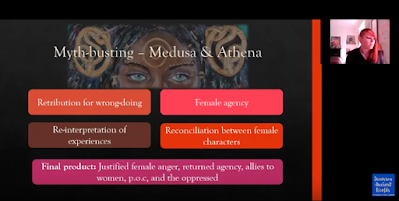
1) Athena and Aphrodite are goddesses who mostly lack a maternal aspect in their characters. Can you comment on how this plays into your interpretations of them in the feminist context discussed?
Starting with Athena, the story of how Hephaistos attempted to seduce Athena comes to mind. The god's seed landed upon the goddesses' thigh, whereupon she wiped it off and threw it to the ground; a child grew from the earth and when he was born Athena returned to claim him as a "foster" mother figure. It is significant that some sources suggest that this child (Erichtonius) had serpent features, which insinuate Athena's maternal connection. With this, Athena manages to maintain her "maidenhood" or independence, but is also able to become a kind of mother. For modern spiritual feminist interpretations, this shows that one does not have to give birth to be a mother, but also that being a mother does not have to occupy ones' indentity.
This is the same with Aphrodite. We know she was physically a mother of Eros and various other deities, but she does not become a "mother goddess". Children are sometimes a consequence of heterosexual sex, and act of union itself is of her primary concern. Modern devotees recognise that though she is mythically a mother, she is not a mother goddess, recognising this ancient understanding.
2) Could you expand on Aphrodite’s modern role in the LGBT+ community?
This is made very clear by the female same-sex love expressed in Sappho's poetry, which often mention Aphrodite as the goddess behind such desire. Temple of Love, written by devotee Laurelei Black, features an erotic encounter between a priestess and the goddess. Beyond literature, Harita Meenee has written an article which suggests how Aphrodite can be an icon and ally for anti-fascist activism in the modern day - which includes LGBT+ activism. I have also seen LGBT+ pride flags included on devotee altars to Aphrodite, suggesting that she is a goddess of inclusive love and sexuality.
3) Do feminists acknowledge Aphrodite's mythic role in arguably trafficking Helen? And are they any connections with Aphrodite's being an "Eve"?
I have not seen this come up in Goddess Spirituality literature. There is certainly mention of the golden apple that started it all, seen to be evidence of Aphrodite's supreme beauty. Aphrodite's role in causing the Trojan War through obtaining this apple is heralded as evidence of her power. But Helen's agency is not a primary issue that arises... However, Aphrodite's questionable behaviour and the dark side of desire (that leads to sexual violence for example) is acknowledged by devotees.
With connection to Eve, certainly Aphrodite and her girdle of irresistable desire is the ultimate tempresses. She is a warning of giving in to desire for dangerous female sexuality - which remains true for the ancient context as well as today; however, feminists seek to question the "danger" of female sexuality, which is seen as a way of demonising and blaming women's bodies for the behaviour of men.
4) You mention the goddesses in terms of feminist 'icons', how does this work with those who genuinely believe in them as deities?
Goddess Spirituality is a feminist approach to spirituality, rather than a religion of tradition itself. This means that adherents believe in a variety of different theisms. Some may see them as archetypes within the psyche - this might be supported by secular feminists too. You often hear such people saying they "work" with the goddesses - as if they go to them to empower themselves first and foremost. Others believe in them as real deities, where they offer devotion (as well as ask for assistance, and seek empowerment). This can be interpreted as seeing the goddesses as many aspects of One Goddess; others interpret them polytheistically. These theisms can also exist all at once for one individual! So for the purpose of this presentation I have opted for "icons", as this is consistent for all. Each approach interacts with the goddesses as icons in some way, with some going beyond this into genuine reverance as deities.
5) Have you looked into "goddess tours" to heritage sites in the Mediterranean?
I could easily dedicate an entire thesis to such a topic! This certainly comes up in my research and I'd love to join a tour to glean insights on how Goddess devotees interact with heritage sites. Pilgrimages are a big part of Goddess Spirituality. It is interesting as many devotees feel as if, because their intentions are spiritual they are somehow above other tourists; some also express that goddess sites are a part of their heritage (regardless of their nationality). On the one hand this means they want to hel protect sites, teaching about them, advocating visits, and donating. On the other, I know of some who break into sites that are usually closed, or who take things from the sites... Much like non-spiritual tourists really.
6) How do feminists reconcile Athena's relationship with women, being supportive but also cruel?
Some see this as a patriarchal corruption and in order to feel empowered through her, they re-interpret Athena's role in myths (such as the myths of Medusa), to make her more supportive. The original is suggested to pit women against women. Even if this new idea is not actually authentic (some think it is) the process of re-writing the myth to stop the cycle of women's abuse of women is seen as empowering.
Others believe Athena is too patriarchal to reconcile and some, such as Carol Christ, wish to avoid war-goddesses completely. There are repeated references to her role in siding with the man figures in Aeschylus' Orestes. But this is one quote, from one play, never read in context, yet magnified in importance for these readers. I feel that such a reading is reductive. Furthermore, to dismiss war goddesses also feels un-feminist to m, and erases how important this was to ancient people - that's just my opinion though.
Question 14 continues this idea...
7) Are there any feminist efforts to push beyond Aphrodite's sphere of love/sex, such as her ancient roles in commerce, which often get omitted. This could be an empowering aspect for modern feminists.
7) Are there any feminist efforts to push beyond Aphrodite's sphere of love/sex, such as her ancient roles in commerce, which often get omitted. This could be an empowering aspect for modern feminists.
This is something that Goddess devotees appear to be very interested in! To some degree, Goddess Spirituality today has access to hundreds of different goddess myths and so if one is looking for a "goddess of the sea", or a "goddess of financial success" they could pick many others who are more popularly known for that today. Likewise, if looking for a "goddess of love/sex" Aphrodite will be one that comes up first. This is because of biases in our records of accessible information today. I think there is also a common trend towards worshipping multiple goddesses to
oversee multiple roles, rather than chose to worship only a few. Despite this, for those who are devoted to Aphrodite, they research her more deeply and discover various epithets and associations. Suddenly she becomes much more powerful, diverse and dynamic. I don't see her role in commerce and trade being popularly mentioned so far - not ignored, but skimmed over as an addition. That being said, I do think that by pushing against Aphrodite's stereotypes more and more roles will become emphasised - and this will be empowering for these feminists. If this could happen in a popular secular context too even better! However, presenting Aphrodite as not a sex/love goddess, and as a powerful complete deity does not serve the needs of those who perpetuate her stereotype; hence why this is such a challenge...
8) Have your Egyptian studies identified any specific links with goddesses in West Africa?
My taught studies in Egyptology did not explore this in any significant detail. My independent research for my two dissertations were based in Predynastic Egyptian iconography and so this was also not an area that extended into West Africa.
9) In feminist spirituality there is a lot of interest in reclaiming not only of sexuality, but of specifically reproductive abilities. This biological capacity is at the root of much of patriachal control over women - so what role does this have in the context discussed?
This is a big controversy right now. We're experiencing the fourth wave of feminism right now - yet your observations are correct, Goddess Spirituality is heavily influenced by the 2nd wave cultural feminism. For many the celebration of some women's reproductive abilities is extremely empowering and should not be dismissed; however, over-emphasising this and making it central is detrimental to many in the community, including other women (cis and trans), male devotees, and non-binary people. This has very painful consequences and I am witnessing a schism occuring.
The bottom line is, the patriarchal control of women's bodies and their reproductive capacities is acknowledged by feminist devotees. Some reclaim this power by reclaiming agency and re-valuing this aspect of their bodies Others do not find this aspect empowering. The way forward is to accept both approaches, honour both but not prioritise either, and create safe spaces to hold both approaches - rather than perpetuating exclusion and demanding that we all agree.
10) Have you read Octavia Butler’s Xenogenesis books involving snake-haired aliens and unchosen transformation? Black is the ur-African American of science fiction.
10) Have you read Octavia Butler’s Xenogenesis books involving snake-haired aliens and unchosen transformation? Black is the ur-African American of science fiction.
I have not! I shall explore as this sounds very interesting and relevant!
11) Women had different experiences in terms of social status, in the context of Greek Ancient Colonization. Is this something that you take into account on your reception approach?
I have not fully moved into this section of my reason, however, when referring to ancient sources it will certainly feature in my analysis. My primary questions would be to ask whether Goddess devotees acknowledge ancient social status? This is especially interesting in terms of their reception of women in religious roles.
12) There are theories of Aphrodite being a version of Ishtar, entering the Greek pantheon through Sparta as a war goddess. This was stripped of her as she intergrated with Greek culture. Is this acknowlegded by Goddess devotees?
Yes! Goddess devotees appear to be very enthused about this concept. It supports their believe that Aphrodite is a goddess of great antiquity as well as one who is much more complex than being a gentle love goddess. This war-nature is not fully explored in terms of the violence that it would accurately entail; but her connection to this is at least surface-level very popularly referenced.
13) In my experience I have seen many retellings of the Persephone myth suggest that the "true"story is not the one recorded in mythology books - as if scholarship is suspect. What have you found to be the most successful way of engaging with people who hold such attitutes?
I have read over and over again that Goddess devotees intend to unearth the "truth" and the "authentic original" version of goddess myths. This is their intention. Their method may not match up with scholarly standards however. My thesis recognises that their is a barrier between the two sides right now which is currently not helpful to either side. Devotees distrust academics who in turn dismiss them. I hope to have more ideas on how best to approach mending this relationship as I come to the last section of my thesis. For now, however, I would say that,
Yes! Goddess devotees appear to be very enthused about this concept. It supports their believe that Aphrodite is a goddess of great antiquity as well as one who is much more complex than being a gentle love goddess. This war-nature is not fully explored in terms of the violence that it would accurately entail; but her connection to this is at least surface-level very popularly referenced.
13) In my experience I have seen many retellings of the Persephone myth suggest that the "true"story is not the one recorded in mythology books - as if scholarship is suspect. What have you found to be the most successful way of engaging with people who hold such attitutes?
I have read over and over again that Goddess devotees intend to unearth the "truth" and the "authentic original" version of goddess myths. This is their intention. Their method may not match up with scholarly standards however. My thesis recognises that their is a barrier between the two sides right now which is currently not helpful to either side. Devotees distrust academics who in turn dismiss them. I hope to have more ideas on how best to approach mending this relationship as I come to the last section of my thesis. For now, however, I would say that,
- There needs to be mutual respect. Scholars need to respect Goddess devotees as a genuine religious group, deserving tof the respect one would offer to any other. Devotees needs to respect the amount of work that scholars pour into their field and their attempts to unearth accurate, peer-reviewed information.
- Empathy. I would like to see more scholars attempt to understand that Goddess devotees approach the ancient world for very different reasons than academics do, and that their aims may indeed not be the same. This is indeed, the nature of reception.
- Multivocality. There is room for hearing many opinions and suggestions!
- Finding commonality. Goddess devotees and scholars both seek to learn more about the ancient past and to protect and preserve it. The two could therefore work together to help this happen!
14) Can Athena be accepted as a feminist without without erasing her "masculine" or misoynistic attributes? Can we have a feminist view of her as a flawed woman with internalized misogyny?
This question really interested me today... There is a tendency to erase and dismiss things as patriarchal corruptions, without fully exploring what they could mean if they were not. Some feminist re-readings have kept her in the role of the punisher of Medusa (like the poet, Patricia Smith). Anwen Haywood who suggested in the 'That's Ancient History' podcast that Athena could represent those of us who have looked away, when something was too uncomfortable to face. In this way, as a flawed woman with internalized misogyny, Athena can be claimed by feminists. Feminists can identify with this truth. The empowering side of this is not obvious at first, however, by accepting our imperfections and places that we need to work on, this acknowledgement of the flawed woman could actually help us a lot.


