Thursday, 23 June 2022

Feminine Power Exhibition

Over the last year or so I have had the honour of working with the British Museum alongside the Children of Artemis as a community consultant for the Feminine Power: divine to the demonic exhibition. Together we met with the curatorial team to provide insights for the section entitled, 'Magic and Malice', which drew specific attention to the fear of women's magic and witches during the Middle Ages.

Olivia Ciaccia standing in front of the exhibit
containing thanks to the CoA consultants


I plan to incorporate some highlights about the exhibition and receptions from the visiting Goddess devotees into my Tangible Heritage thesis chapter. In the meantime I have written a short blog post about the exhibition for Mainly Museums, which you can read here.


Sunday, 23 January 2022

What have I been up to these last months?

As the chaos of the winter holiday and new year draw to a close (hopefully!) I thought it was appropriate to provide some updates about what I have been up to over the Autumn and Winter past.

- Following on from my trip to Greece at the end of September 2021 - where my partner and I consumed as much history 10 days would allow - I spent October finalising my Round 3 questionnaire and passing the ethics review before sharing it with potential respondents (Round 3: https://forms.office.com/r/90jCVUTKMn). 

- In October I submitted an article to the Children of Artemis's Witchcraft & Wicca magazine. Here I outlined my study and invited readers to participate. (At the time of writing I thought I would be unable to include my Sekhmet chapter in the thesis - but since realised that I can!) I also submitted an small advert to the Pagan Federation's Samhain issue of Pagan Dawn magazine.

Article in issue 36 of Witchcraft & Wicca magazine.


- In November I received peer reviewer and editor comments for an article I submitted to the Pomegranate Journal back in December 2020. I spent this month implementing the comments and suggestions, and ended up editing more than I had anticipated.

- Thanks to the Keil Scholarship award, of which I am a recipient, I was able to partake in an online course by GIRES entitled 'Introduction to Digital Humanities'. It is my hope that such courses will upskill me for a future career in the heritage industry.

- December was primarily occupied with personal matters and the winter holidays.

- This January I have been editing the final draft of my chapter for the Women in Classical Video Games edited volume, following peer reviewer and editor comments. Happily, I submitted this today!

This week I am due to submit documentation for my second Annual Progress Monitoring (APM), supporting my continued PhD candidature. As soon as February arrives I will be returning my full attention to the thesis itself. My next steps are:

  • Reach out to more Goddess Communities, feminist and organisations, and religious studies organisations, advertising the project and questionnaires.
  • Make progress on my reading list for Chapter 6 (Engagement with Heritage & Scholars).
  • Start drafting paragraphs into Chapter 6.


Wednesday, 27 October 2021

Cover reveal for 'Women in Classical Video Games'

I am absolutely thrilled to share the cover for the forthcoming volume, Women in Classical Video Games, edited by Jane Draycott and Kate Cook (published by Bloomsbury Classical Studies & Archaeology).

Every chapter sounds fascinating to me and I cannot wait to read through! It is also where my debut (scholarly) publication will appear, in a chapter entitled: 'Opening Pandora's Box: Aphrodite as the representation of women's sexuality in God of War III'. Once published, I will share details for ordering the book.


Sekhmet chapter re-introduced into the main thesis

A few months back I reluctantly decided to remove my Sekhmet chapter from the main thesis, owing to word count, resigning myself to publish it separately. However, this week my partner and fellow PhD student Thomas Husøy sat down with me and realised that I had miscounted and had plenty of room remaining! (I don't know how I had got it so wrong...). So, Sekhmet is back in the thesis and I am now plotting the course of my final chapter: Engagement with Heritage & Scholars. The discussions on tensions and mutually beneficial relationships will be partly featured here and in the thesis conclusions.

My revised thesis plan is now thus:

     1. Introduction (part-drafted)
     2. The Reception of Ancient Goddesses ✔
     3. Case Study: Aset-Isis ✔
     4. Case Study: Aphrodite (case study)✔
     5. Case Study: Sekhmet ✔
     6. Engagement with Heritage & Scholars (in process)
                                                                        7. Conclusions (not started)

Today I also officially sent off my final questionnaire for ethics review. Once it is accepted all 3 questionnaires will be available to participants, and I have created nice adverts for the occasion!


Saturday, 9 October 2021

Updates so far

I have now submitted three/four thesis chapter drafts to my supervisors, with one more to write before I tackle my introduction and conclusion!

  • 1. Introduction (part-drafted)
  • 2. The Reception of Ancient Goddesses ✔
  • 3. Isis (case study) ✔
  • 4. Aphrodite (case study)✔
  • 5. Towards a Mutually Beneficial Relationship (in process)
  • 6. Conclusions (not started)

I have one more questionnaire to release for my upcoming section 5, where I am going to delve deeper into the sources of tension between Goddess devotees, scholars, and heritage professionals, and suggestions from each community for moving towards a more mutually beneficial relationship. This questionnaire will be focused on devotee engagement with heritage sites and museums.

My previous two questionnaires will remain open until the start of my final editing process (expected January 2023), so please do continue sharing them!

So far I have had the privilege to interview 21 devotees through video call and email, and have had around 200 questionnaire responses. I still welcome more interviewees, as well as photographic submissions of altars and GS material culture.

Isis at Marathon, Greece
 
Some of you may be wondering what has happened with my third case study on Sekhmet: owing to a limited word count, however, this will need to be published in the eventual thesis monograph (fingers crossed) and/or edited for submission to an academic journal. I very much enjoyed writing that chapter, and had some great responses from Sekhmet devotees - so I promise, this will still be published, though separate to the thesis.

In other news, I have just returned from a week in Greece, spent with my partner exploring as many heritage sites and museums as we could! I will endeavour to share some of my highlights on this blog in due course - especially those relating to Greek goddesses.

I have also signed for a training course this November, focused on Digital Heritage, which I am sure will be of benefit to my ethnographic research, as well as future career prospects.

For now, onto the next chapter!

Saturday, 21 August 2021

Seeking Goddess Questionnaire Respondents

My name is Olivia and I am a PhD student at the University of Bristol, researching how adherents of Goddess Spirituality revive ancient Mediterranean and Egyptian goddesses in the 21st century. My goal is to determine ways that we can build a mutually beneficial dialogue between Goddess devotees and scholars of the ancient world. With this, I aim to include different perspectives and experiences within Anglo-American Goddess Spirituality, from people of various ethnicities, sexual orientations, genders, and physical abilities.

If you,
  1. Identify with Goddess Spirituality, 
  2. Engage in Goddess communities in the UK or US
  3. And engage with ancient Mediterranean Goddesses
then I invite you to respond to my thesis questionnaires!


Round 1 is about your spiritual path (in Goddess Spirituality) and how you came to learn about ancient Goddesses: https://forms.office.com/r/s3acd2MvvJ

Round 2 is for those who engage with Aphrodite, Aset-Isis, and/or Sekhmet: https://forms.office.com/r/wHqrjKRn35

You can also request a posted hard copy or a digital download by emailing me at: hg19310@bristol.ac.uk .

Modern altar featuring a replica figurine of a statue of Isis
found in Pompeii


Friday, 7 May 2021

Round 2 Questionnaire available!

The time has come for Round 2 of my thesis research on Anglo-American Goddess Spirituality in the 21st Century! This time it focuses on the modern veneration of APHRODITE, ASET-ISIS, and SEKHMET. You can respond to it through this link:

https://forms.office.com/r/wHqrjKRn35 

Or you can also request a downloadable digital copy / a paper copy in the post by emailing me: hg19310@bristol.ac.uk

You can also still respond to the Round 1 questionnaire here (the more the merrier!).

To participate in this research, you should fulfil the following:


You are based in the UK or the US (regardless of your nationality), OR you frequently engage with a Goddess Spirituality community in these locations.
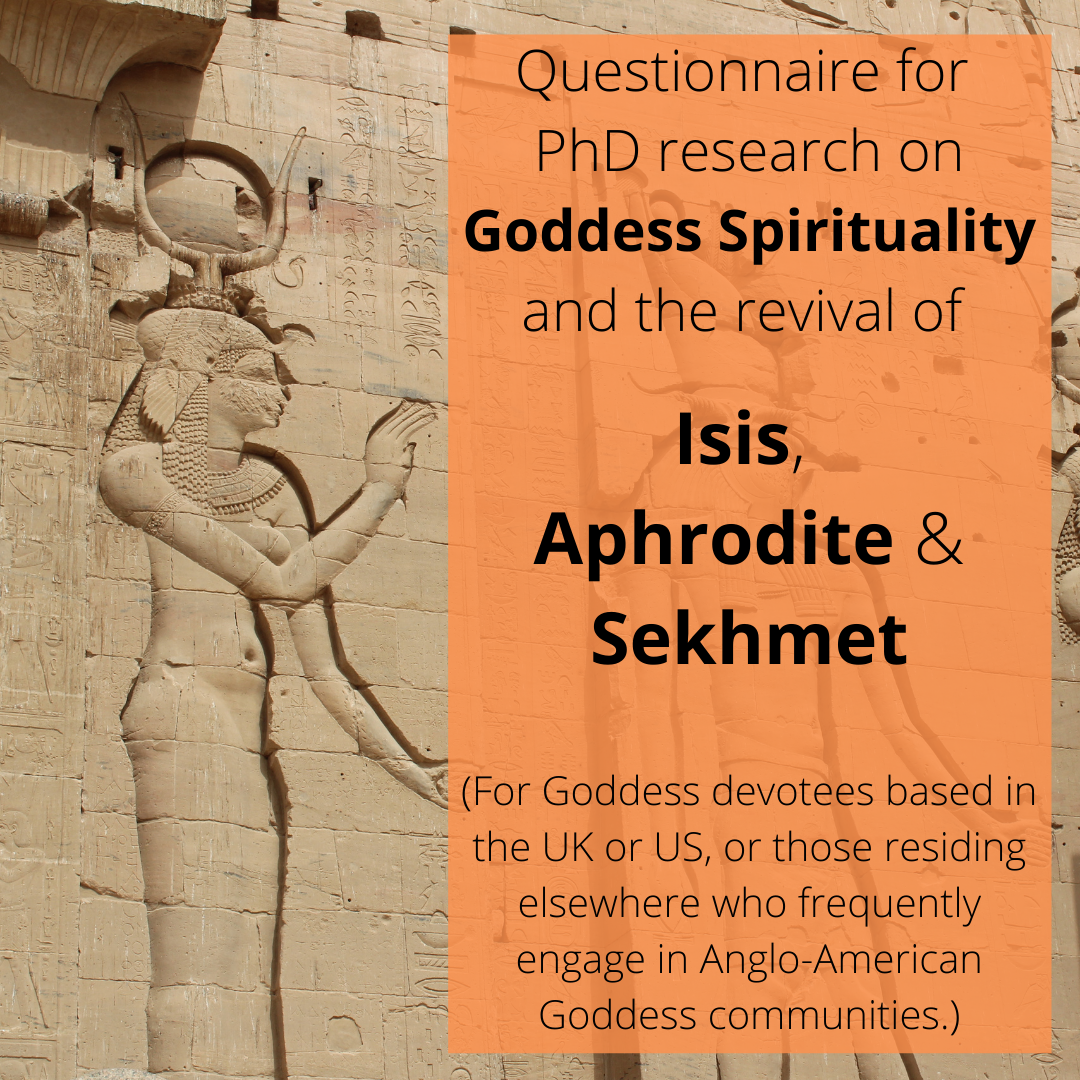
You identify with ‘Goddess Spirituality’

And your spiritual path involves the goddesses, Aphrodite (and Venus), Aset-Isis, or Sekhmet.

There are other ways to get involved with my research too! Check on this blog page.


Thursday, 15 April 2021

Pagan Federation 50th Anniversary

This is just a quick message to say that I will be speaking for the Academic Conference part of the Pagan Federation's 50th Anniversary, on the 24th July 2021!

For information about the event please check here: https://www.paganfed.org/50th-anniversary-celebrations/

Event trailer


Monday, 18 January 2021

Moving into my second year of research!

On Wednesday 13th January 2021 I underwent my Annual Progress Monitoring (APM) interview to confirm that I was ready to move into my second year of research. Suffice it to say, I will be progressing! It was actually super nice to audibly talk about my research with the examiners, as for the last 10 months of my first year we've all been in lockdown, more or less. 

I haven't visited Bristol since February. The last (and my first) scholarly talk I presented was for the Myths and Politics seminar series back in June. A PhD can often be a lonely experience, but during 2020 it was even more so. Added to this, is the practical limitation of only being able to access online resources and having no study space outside of our (currently very cold) house. BUT the university library has been very obliging with my eBook requests and I'm glad to be in a safe place with the company of my partner and our cat!

Moving forward, after a supervisory meeting today with Prof. Hutton I have better clarity on my thesis structure. My exploration of my thesis subject will now take the form of three case studies examining the ancient and modern veneration of Aphrodite, Aset-Isis, and Sekhmet. Fortunately I have already written a case study on Aphrodite in preparation for my APM, which I can use the bulk of the official chapter. I also have an article about devotees engaging with statues of Sekhmet in museums (pending acceptance) which can contribute to the chapter on her as well. So I feel that I am in a rather secure place.

My immediate attention will be directed towards my first chapter before the case studies, where I will lay out the context for the revival and innovation of these goddesses in 21st century Goddess Spirituality. Once I have done this I will construct my Round 2 questionnaire aimed towards devotees who revere Aphrodite, Aset-Isis, and Sekhmet - which will get me into the juicy part of this project!


Saturday, 2 January 2021

A Quick Summary of R1Q Quantitative Findings

I want to extend a huge thank you to those who responded to and shared my thesis' Round 1 Questionnaire! I received 113 responses that I could use and am delighted!

I thought it would be of interest for many questionnaire respondents to have a glance at some of the trends I found in the quantitative questionnaire data for Round 1. To avoid publishing my research prematurely I have offered non-statistical summaries below.

  • The majority of respondents identified as feminists and considered this relevant to their spiritual path. However, not all of them did identify this way, and some who were feminists didn't think it was relevant to their spirituality. Based on the responses of these people, feminism is a common component of 21st century Goddess Spirituality, but is by no means a requirement.
  • The majority of respondents accepted the label of ‘Pagan’, with some exceptions who did not think it was a suitable term.
  • Respondents demonstrated a high level of theistic flexibility and the view that multiple theisms could coexist at once. Nevertheless, the most common ways of viewing goddesses was either as archetypes or through polytheism.

  • The language most commonly used to describe one's interaction with goddesses was relational: 'connection' and 'working with', rather than in supplication.
  • Almost all respondents had an interest in ancient history, with just over half having this interest before discovering their spiritual path.
  • Ancient Greek and Egyptian goddesses were amongst the most popular Mediterranean goddesses mentioned, namely, Hekate, Aphrodite, Artemis, Isis, and Sekhmet. Amongst these popular names, there were over 200 additional ones listed, demonstrating a greater awareness of ancient pantheons than the general public. 
  • Respondents predominantly learned about ancient goddesses through a combination of scholarly and spiritual sources, considering each to have its own merits and uses. Overall, respondents valued sources that were historically accurate and wanted spiritual sources to make it clear when they were talking about historical facts versus personal gnosis.
    • There were a few respondents who said that they preferred scholarly resources, however, their listed favourites would not meet current archaeological approval. As such, what is considered as specialised scholarship is a subjective matter. 

Search This Blog