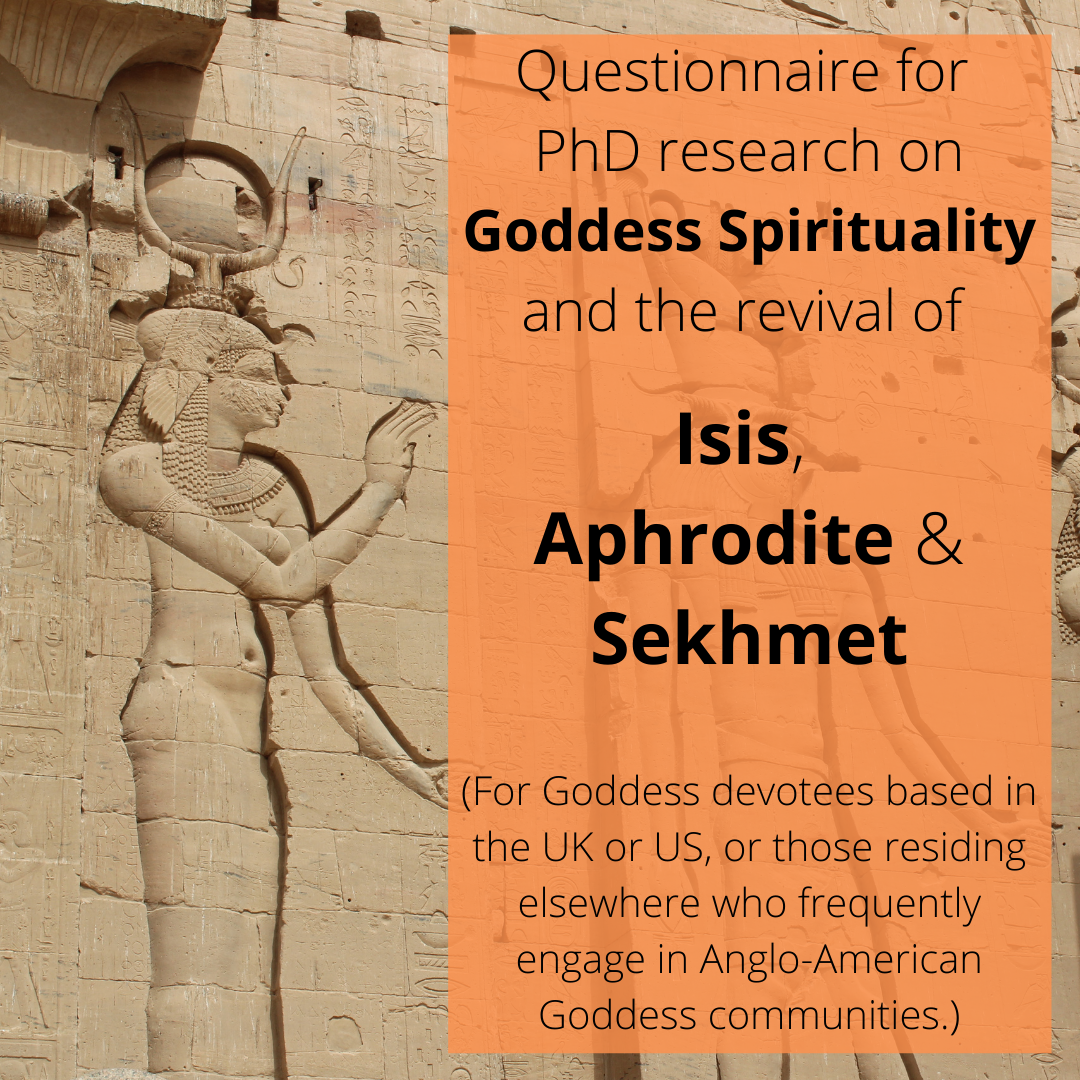
Since releasing my Round 1 Questionnaire, I have decided to alter my suggested characteristics defining 21st century Goddess Spirituality. To make it more interesting I have chosen to share these as a series of Instagram images (@teawathena), which I also post here:
Transcriptions:
IMAGE 1 - 'what is Goddess
Spirituality? Five common features'
IMAGE 2 - 'Goddess Spirituality
can be considered an approach to spirituality, rather than a unified tradition
itself. Under the umbrella of Goddess Spirituality there are many different
traditions and cultures. Adherents have various practices and use different
labels for their spiritual identity (i.e. witch, priestess, druid, Goddess
devotee etc.).'
IMAGE 3 - 'Though the approach is
recognised as emerging from a culmination of western second-wave feminism,
counter-culturalism, New Age philosophy, and neo-Paganisms during the 1970's,
Goddess devotees maintain that they are reviving and innovating beliefs once
held by ancient religions that revered Goddesses and nature. Goddess
Spirituality in the 21st century is multi-generational and international, followed
by people of all genders, backgrounds, and ethnicities.'
IMAGE 4 - '1. Goddess-centred.
One of more Goddesses are the central focus. Some devotees revere Goddess/es
exclusively, whilst others may revere male and androgynous Gods too (though
with Goddess/es taking precedence). Goddess Spirituality contains a range of
theisms, from monolatry to polytheism, as well as some devotees who prefer to
view Goddesses as archetypes'
IMAGE 5 - '2. Feminist /
Activist. Goddess Spirituality seeks an alternative to androcentric religions,
cultures, and oppressive power-over systems. This manifests through various
forms of feminism, as well as personal and/or social activism. Some devotees
focus their efforts on personal empowerment, whilst others may combine this
with political activism, such as environmentalism and advocating for human
rights.'
IMAGE 6 - 'Inspired by the
ancient world. Religio-spiritual beliefs and practices may take inspiration
from prehistory and ancient religions involving Goddesses and female mythological
figures, with a common interest in exploring herstory. Ancient ideas, beliefs,
myths, and practices are revived and/or re-interpreted to suit the needs of
devotees in the modern world.'
IMAGE 7 - '4. Non-dogmatic &
self-led. As Goddess Spirituality is an approach to spirituality and not a
religion or tradition itself, there is no dogma or prescribed beliefs and
practices. Goddess devotees are encouraged to exercise their own agency in
spiritual expression and to develop a relationship with divinity; as such,
personal gnosis and experiences take priority.'
IMAGE 8 - 'Sacred Corporeality.
The physical world, nature, bodies, and certain objects are believed to hold
sacred meaning and be expressions of the divine. Spirituality is experiential
and something that can be felt through the body. Goddess devotees believe the
Earth to be sacred and that they themselves are a part of the divine. They
often make pilgrimages to sacred sites and utilise sacred iconography and
ceremonial tools.'
IMAGE 9 –‘The characteristics
above relate to Goddess Spirituality as an approach, rather than reflect any
specific traditions or groups who identify with it. As such, Goddess devotees
and groups do not have to meet every one of these characteristics in order to
identify with Goddess Spirituality. Some characteristics might overlap with
other spiritual paths and traditions belonging to contemporary Paganism and
alternative spirituality.'
IMAGE 10 - 'want to find out more
and contribute your ideas? Follow Instagram @teawathena, Twitter
@teawithathena, http://teawithathena.blogspot.com/


 You are based in the UK or the US (regardless of your nationality), OR you frequently engage with a Goddess Spirituality community in these locations.